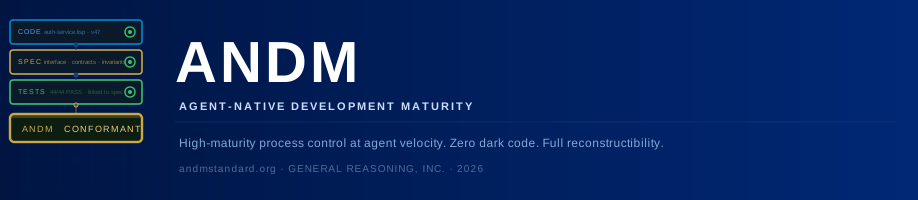
ANDM v1.0 — Inaugural Standard
CMMI Level 5 was always the right answer.
Agent-Native Development Maturity (ANDM) is a conformance standard for organizations
in which AI agents function as primary code executors. It defines the artifact
governance model, audit substrate, and reconstruction requirements needed to
support high-maturity software process control at agent velocity.
The industry did not reject CMMI Level 5 because the goal was wrong.
It rejected it because the human execution cost made it irrational at commercial velocity.
That constraint no longer exists.
AI agents collapse the marginal cost of governance evidence generation, conformance
checking, artifact maintenance, and causal review. The comprehension gate a senior
engineer would spend days applying can now be assisted in minutes. The measurement
infrastructure, artifact generation, audit trail, and causal analysis become native
byproducts of the development operation itself.
But agents introduce a new risk CMMI Level 5 was not designed to address: dark code.
Code generated by AI, passing automated checks, shipping without the comprehension
step ever occurring. An organization that deploys agents without ANDM-conformant
infrastructure is not moving fast. It is accumulating dark code at agent velocity.
Three invariants
Dark factory, not dark code
The organization's internal development process may be opaque to external parties. The code produced by that process must not be opaque to the organization itself. Every artifact must be comprehensible, traceable, and reconstructible from its genesis record.
Auditability is authorization
The audit record is not a receipt applied after work completes. It is the gate token that authorizes the next unit of work. No governed operation proceeds without a preceding attestable record. This is the mechanism, not a policy.
Reconstruction over recovery
The goal is not backup. It is the ability to reconstruct the organization's complete digital state — and the decision lineage that produced it — from first principles. Any catastrophic event that destroys artifacts must leave the reconstruction roadmap intact.
Progression from CMMI Level 1 to Level 5
ANDM is not an all-or-nothing maturity claim. It defines a staged path from
ad hoc agent-assisted development to quantitatively managed, continuously
optimized agent-native software production.
1
Initial
Agent use is ad hoc. Code may be generated, tested, and shipped without durable organizational comprehension.
DARK CODE RISK
2
Managed
Agent work is planned and tracked. Each governed operation is tied to an accountable human principal and authorization record.
AUTHORIZED
3
Defined
Domains, hubs, spokes, commit records, code, specs, and test-results become standard organizational primitives.
STANDARDIZED
4
Quantitatively Managed
Metrics derive directly from the audit substrate: change frequency, failure rate, stale tests, recovery time, drift, and rework.
MEASURED
5
Optimizing
The spec-as-eval flywheel closes the loop: specs generate tests, tests validate code, failures update specs and process rules.
OPTIMIZING
The Level 5 Module Hub Standard
A module hub is a hub whose subject is a software module — a discrete, deployable
unit of code with a defined interface and explicit dependencies. The Level 5 Module
Hub Standard defines the minimum spoke configuration required for ANDM conformance.
This is the anti-dark-code guarantee made structural.
Spoke type
Required
Conformance requirement
code
Yes
Canonical, versioned source. Must be co-versioned with the spec spoke — a code update without a corresponding spec update is a conformance violation.
spec
Yes
Markdown. Must be sufficient to reconstruct the module without the code spoke. Required: purpose statement, public interface, contracts, data store interactions, known invariants, failure modes. If the code spoke were deleted, an agent must be able to regenerate it from this spoke alone.
test-results
Yes
Structured output from the testing framework against the current code/spec batch. Linked to spec assertions that generated the tests. Test results tied to any prior code/spec state are stale and non-conformant.
commit-record
Auto
Structural primitive. Auto-created with hub. Not governed by this standard. Exists at hub tier independent of content spokes.
The spec spoke test is simple and binary: if the code spoke were deleted, could an agent
regenerate it from the spec spoke alone? If the answer is no, the spec is not conformant.
CMMI Level 5 mapping
ANDM does not replace CMMI and does not itself constitute a formal CMMI appraisal.
It provides the agent-native infrastructure through which an organization can
generate the evidence, control structure, and continuous improvement loop associated
with CMMI Level 5 software process maturity.
CMMI Level 5 Practice Area
ANDM Satisfaction
Causal Analysis and Resolution (CAR)
The commit record hierarchy at domain, hub, and spoke level provides causal lineage for every artifact change. Root cause investigation begins as a read operation on the chain, rather than as an archaeology exercise.
Organizational Performance Management (OPM)
Domain commit records provide a complete timeline of organizational-level artifact motion. Performance metrics derive from the chain without separate instrumentation overhead.
Quantitative Project Management (QPM)
Hub commit records provide per-module change frequency, defect introduction rate via test-results spoke, and recovery time metrics. Quantitative management data is queryable against the Chandra substrate.
Continuous Process Improvement
The spec-as-eval flywheel implements the optimization loop at agent velocity: spec assertions drive tests, tests validate code, failures update specs and process rules.
Configuration Management (CM)
Cryptographic sealing of the spoke chain gives every artifact version an immutable record. Rollback is a new append, not a rewrite.
The audit substrate
ANDM conformance requires an append-only, cryptographically sealed audit substrate.
Chandra is the reference implementation.
A conformant substrate must be append-only, cryptographically sealed per CU,
carry attribution on every CU, be agent-readable as primary audience, and be sufficient
to reconstruct the organization's governed artifact set from genesis.
The test-results spoke requirement in ANDM conformant hubs is populated by the
Chandra Testing Framework.
The design gate embedded in that framework — if the test cannot be written as
before → after → regex, reconsider the element — is the structural
implementation of the spec-as-eval requirement.
General Reasoning, Inc.
· Birmingham, Alabama · Open standard · CC BY-ND 4.0 · 2026
Standard identifier: ANDM-v1.0 · CMMI mapping: CMMI-DEV v2.0
Audit substrate reference: Chandra Protocol
Enterprise inquiries: inquiries@genreason.com