ANDM Adoption Profile
Progression from CMMI Level 1 to Level 5.
ANDM is not an all-or-nothing badge. It is a staged path from ad hoc agent use to
quantitatively managed, continuously optimized, reconstructible software development.
1
Initial
Agent use is ad hoc. Code may be generated, tested, and shipped without durable organizational comprehension.
DARK CODE RISK
2
Managed
Agent work is planned and tracked. Each governed operation is tied to an accountable human principal and authorization record.
AUTHORIZED
3
Defined
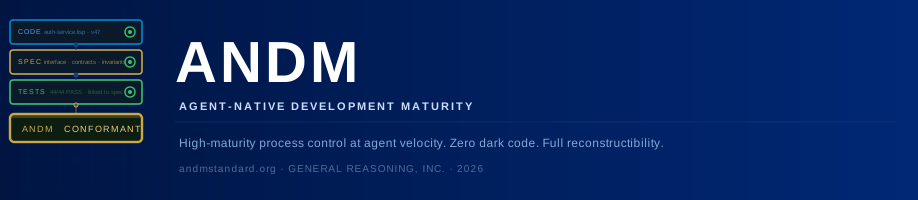
Domains, hubs, spokes, commit records, code, specs, and test-results become standard organizational primitives.
STANDARDIZED
4
Quantitatively Managed
Metrics derive directly from the audit substrate: change frequency, failure rate, stale tests, recovery time, drift, and rework.
MEASURED
5
Optimizing
The spec-as-eval flywheel closes the loop: specs generate tests, tests validate code, failures update specs and process rules.
OPTIMIZING
Detailed progression
Level
Agent-native failure mode
ANDM control progression
1 — Initial
Agents generate code, tests, docs, and fixes without durable organizational comprehension.
Begin recording human and agent actions as Context Units: principal, agent, artifact, timestamp, and operation.
2 — Managed
Teams have tickets and repos, but agent actions are not structurally tied to authorization or evidence.
Require every governed agent operation to have a preceding authorization CU and a hub-level batch record.
3 — Defined
Each team invents its own prompt discipline, review scheme, and artifact structure.
Standardize Domain / Hub / Spoke structure and mandatory module hub spokes: code, spec, test-results, commit-record.
4 — Quantitatively Managed
Agent velocity creates more work than humans can inspect, forcing reliance on incomplete dashboards.
Derive metrics directly from Chandra: drift, stale tests, change frequency, failure rate, recovery time, and bypass attempts.
5 — Optimizing
Agents accelerate both production and error propagation unless the system learns from failures structurally.
Activate the spec-as-eval flywheel: spec assertions generate tests; failures update specs, code, and process rules.
Level 5 is not a slogan. In ANDM, it means the improvement loop has become a governed machine-native process.
General Reasoning, Inc.
· Birmingham, Alabama · Open standard · CC BY-ND 4.0 · 2026
Standard identifier: ANDM-v1.0 · CMMI mapping: CMMI-DEV v2.0
Audit substrate reference: Chandra Protocol
Enterprise inquiries: inquiries@genreason.com